
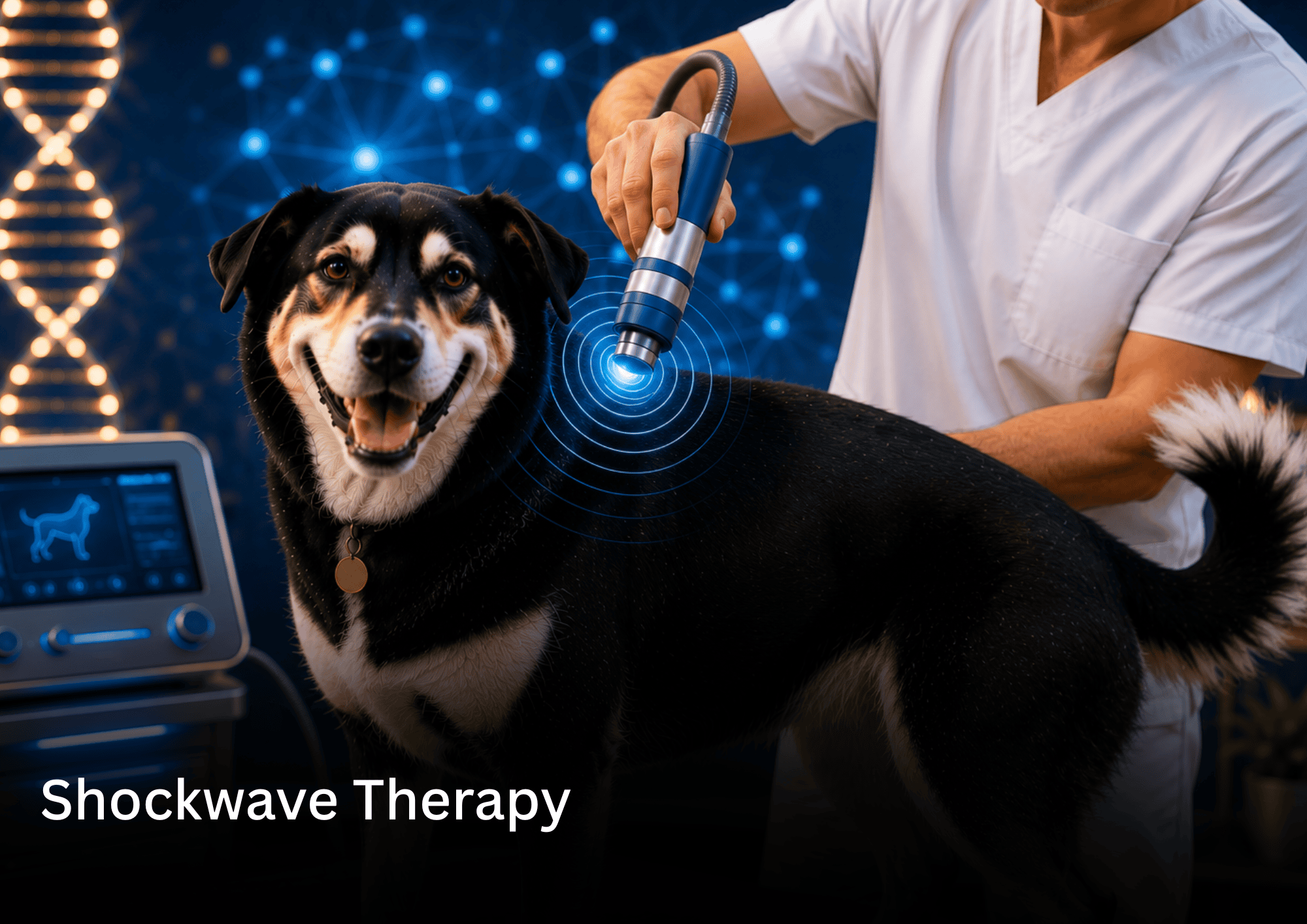
A focused sound-wave therapy that wakes up the body's own healing cells to ease pain, rebuild tissue, and restore movement — offered in person at our West Palm Beach location, and shared here as part of The Biohacked Dog's commitment to being the trusted resource on canine biohacking and holistic dog health.
What It Is
Extracorporeal Shockwave Therapy (ESWT) — extracorporeal simply means 'outside the body' — uses a handheld device to send focused bursts of sound energy through the skin to an injured area. It reached eeper than laser or ultrasound, and it's the only one of the three that can stimulate bone cells to grow, making it especially useful for slow-healing fractures and deep joint or tendon issues.
A few things happen when the sound waves reach the injury site:
- Pain signals get crowded out — the waves flood the area with harmless signals that compete with pain signals on their way to the brain, effectively turning down the volume on pain.
- Cells switch into repair mode — the waves create tiny bubbles in the fluid around each cell; as those bubbles form and collapse, they gently stimulate the cell wall and trigger the body's repair response.
- Blood flow increases — small blood vessels open and new ones form, bringing oxygen, nutrients, and healing growth factors to the injury while clearing away swelling and waste.
It's non-invasive, requires no cuts or sedation for most dogs, and delivers a firm but gentle tapping sensation rather than pain.
What It Helps With
- Joint problems - including hip dysplasia, elbow issues, and arthritis, by easing swelling and calming irritated nerves
- Soft-tissue injuries - torn ligaments, sore tendons, and tight muscles; helps fibers rebuild aligned and strong rather than weak and disorganized
- Slow-healing or stalled fractures - stimulates new bone-building cells to help close gaps that aren't healing on their own
- Chronic wounds - improves circulation to help stubborn skin sores close and heal
- Chronic back pain - reaches deep spinal joint pain that's hard to treat with surface-level therapies
- General mobility & activity level - many dogs return to stairs, play, and normal walks within days of starting a course
What to Expect
In West Palm Beach: The Biohacked Dog offers shockwave therapy in person, performed by our trained team as part of your dog's care plan.
Not local? This guide reflects the same standard of care we hold our own sessions to, so you know what to look for and expect wherever you go.
Before the session: your dog's gait and movement are evaluated, and sore or tight areas are identified by hand. Imaging like X-rays or ultrasound may be used for a clearer picture before building a treatment plan. A few conditions rule out shockwave therapy — active tumors, lung issues, and active infections are avoided, and it's not used until a puppy's growth plates have closed. Pregnant dogs receive a modified, gentler approach. Prep is simple: a calm walk beforehand (so your dog can go potty), skipping a large meal, and bringing a favorite blanket or toy can help your dog relax.
During the session: a small patch of fur may be trimmed, and cooling gel is applied to help the sound waves travel cleanly. The handpiece delivers quick, rhythmic pulses — a firm tapping sensation, not a painful one. Most dogs stay calm, and many relax, stretch out, or nap. Sessions typically run about 30 minutes.
After the session: keep the rest of the day calm — short walks only, no jumping, roughhousing, or stairs. By day two, gentle leash walks on soft ground are usually fine, along with any light stretches your team recommends. Mild, short-lived effects like pink skin or next-day tenderness (similar to a workout ache) can happen but are not a cause for concern.
How many sessions: this varies by condition rather than following one fixed number. A fresh muscle pull often needs just 2 sessions, a week apart. Long-standing arthritis typically calls for 3 to 4 sessions over about a month. A slow-healing fracture may need around 6 sessions spread across 8 weeks. Your team adjusts the plan along the way based on your dog's progress
Breed-Specific Notes
- Small & toy breeds (Chihuahua and similar) - shockwave therapy is safe for smaller dogs; power and pulse settings are adjusted to fit their size.
- Senior dogs of any breed - often benefit the most, since shockwave therapy eases pain without adding strain to the liver or kidneys the way some long-term medications can.
- Large & giant breeds (Labrador Retriever, German Shepherd, Golden Retriever, Great Dane) - higher rates of hip dysplasia and elbow issues; shockwave is commonly used to manage joint pain and delay or reduce the need for surgery.
- Long-backed breeds (Dachshund, Corgi) - the chronic back pain application may be especially relevant given elevated spinal/IVDD risk in these breeds.