
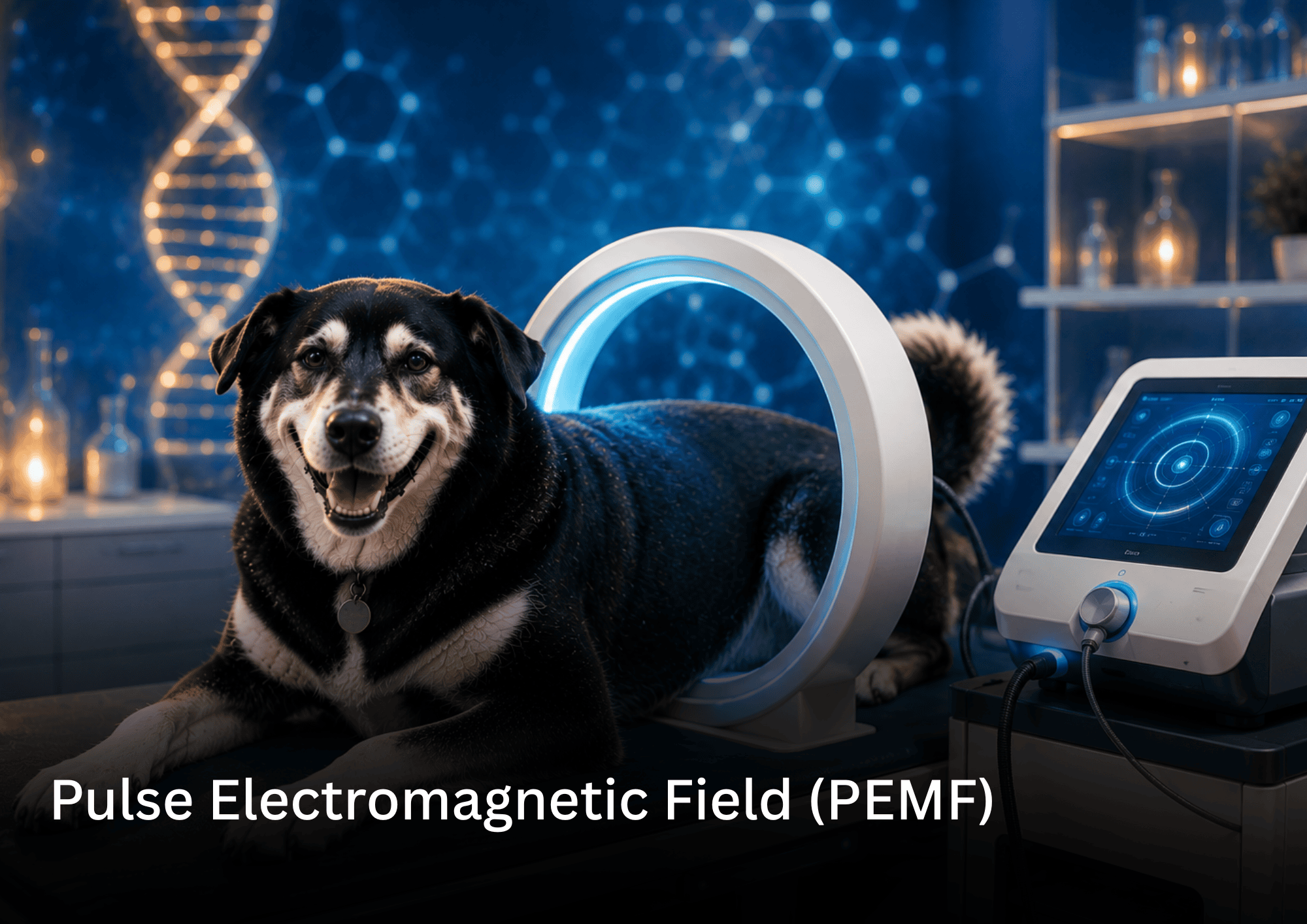
A gentle, non-invasive therapy that eases pain, supports healing, and calms inflammation — offered in person at our West Palm Beach location, and available as guided at-home care, shared here as part of The Biohacked Dog's commitment to being the trusted resource on canine biohacking and holistic dog health.
What It Is
PEMF, or pulsed electromagnetic field therapy, uses a gentle, changing magnetic field delivered through a coil or pad placed near or under your dog's body. It's a non-invasive, drug-free way to support your dog's own healing processes at the cellular level — no needles, no sedation, and no downtime.
When the magnetic field passes through your dog's tissue, it triggers several natural responses in the body:
- Reduced inflammation – the field is believed to calm the inflammatory response in the treated area, easing swelling and discomfort.
- Better circulation – blood flow increases to the treated tissue, bringing oxygen and nutrients that speed healing
- Pain relief – many dogs need less pain medication as circulation and healing improve.
- Cellular support – the field may influence how cells signal and repair, supporting bone healing and tissue recovery.
What It Helps With
- Joint pain & arthritis – one of the most common and best-supported uses, especially for hip and elbow osteoarthritis
- Recovery after surgery or injury – supports faster wound healing and may reduce how much pain medication is needed
- Slow-healing fractures – used as an adjunct when bone healing is delayed or not progressing well
- Post-operative swelling – particularly after orthopedic or spinal procedures
- Age-related stiffness – senior dogs frequently see improved comfort and mobility as part of ongoing care
What to Expect
In West Palm Beach: The Biohacked Dog offers PEMF sessions in person, using a clinical-grade device as part of your dog's care plan — often paired with other modalities like acupuncture or rehab.
At home: For ongoing support between visits, or if you're not local, we can guide you toward a safe, appropriately dosed PEMF device for home use, and help you build a simple protocol around your dog's specific condition.
Not local and don't want a device? This guide reflects the same standard of care we hold our own sessions to, so you know what to look for and expect wherever you go.
Before the session: your dog's health history and current symptoms are reviewed to identify the right settings and treatment area. No special prep is needed — most dogs can go straight from a normal day into a session.
During the session: your dog rests comfortably near or on the PEMF applicator in a quiet setting for 10 to 20 minutes, depending on the condition being treated. Most dogs tolerate this well and many relax or doze off, since there's no sensation of pain from the treatment itself.
After the session: it's normal for a dog to seem a little tired or extra mellow for the rest of the day. Some owners notice looser movement or eased stiffness within the first day or two, though full benefits build gradually with
consistent use.
How many sessions: this isn't typically a one-and-done treatment. Many dogs start with sessions two to three times a week, then taper to a maintenance schedule as symptoms improve. Chronic conditions like arthritis usually need several weeks of consistent use to see the full benefit.
Breed-Specific Notes
Some breeds are more likely to benefit from PEMF as a proactive part of their care, based on known predispositions:
- Large & giant breeds (Labrador Retriever, German Shepherd, Golden Retriever, Great Dane) – higher rates of hip dysplasia and joint arthritis; PEMF is often used alongside joint supplements as a long-term mobility strategy
- Breeds prone to orthopedic surgery (Labrador Retriever, Boxer, Rottweiler) – commonly use PEMF post-operatively to support healing after cruciate ligament repair or other orthopedic procedures.
- Long-backed breeds (Dachshund, Corgi) – PEMF may be used in recovery-focused care for IVDD, alongside other rehab modalities
- Small & toy breeds (Chihuahua, Yorkshire Terrier) – typically use lower-intensity settings and shorter sessions given their size and sensitivity.
- Senior dogs of any breed – a common entry point regardless of breed, as age-related stiffness and slower recovery are universal