On an April night a few years ago, my dog Grace was hit by a car. She was off-leash the way she always was, trusted after years of understanding traffic, streets, and staying close. I was distracted on a phone call. She turned back to cross the street behind me, and by the time I …

On an April night a few years ago, my dog Grace was hit by a car. She was off-leash the way she always was, trusted after years of understanding traffic, streets, and staying close. I was distracted on a phone call. She turned back to cross the street behind me, and by the time I looked up, a car was already coming. I couldn’t stop it in time. She rolled under the bumper, went silent, and I carried her to the car not knowing if she’d walk again.
At the emergency vet, the X-rays showed what looked like a hip fracture in three places and possible nerve damage in her left shoulder. She couldn’t stand. The standard plan was time, medication, and a neurologist follow-up in four to six weeks. I wasn’t willing to just wait and hope. I called around and found Dr. Holland, a veterinarian who works with integrative and biohacking-oriented modalities — acupuncture, shockwave therapy, PEMF, and Chinese herbal medicine among them. She came out that same weekend and gave Grace her first treatment. When I asked her, with tears in my eyes, whether this was the end, she told me: give me two weeks, and she’ll be walking again.
This post is about what those two weeks looked like, and specifically about the role Chinese herbal medicine played alongside the other therapies Grace received. Before trying anything like this with your own dog, talk to your veterinarian first — stabilizing an injury, getting real diagnostics, and ruling out anything life-threatening always comes before any complementary therapy. With the right team, though, this kind of integrated approach can genuinely change a recovery timeline.
Why Consider Chinese Herbal Medicine After a Traumatic Injury
A car accident, a fall, or any sudden blunt trauma puts a dog’s body through a lot at once: tissue
damage, inflammation, bruising, nerve irritation, and often significant pain and shock. Standard
veterinary care — diagnostics, pain management, and time — is the essential foundation, and it’s not optional. But TCVM views trauma recovery through an additional lens: supporting circulation to the injured area, reducing blood stasis (the traditional term for the bruising and swelling that trauma leaves behind), and calming an overstressed nervous system.
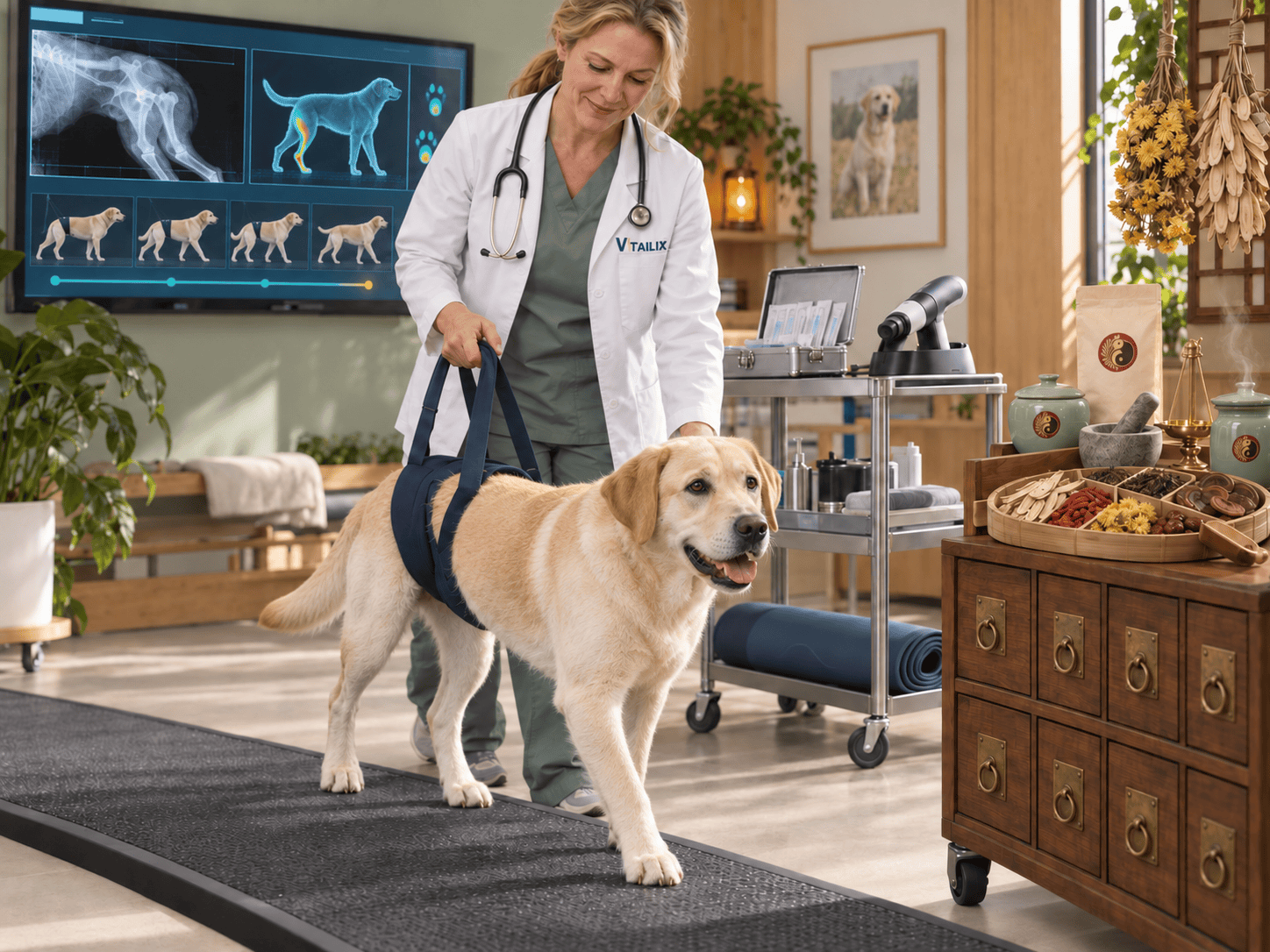
In Grace’s case, her care team layered several modalities together rather than relying on any single one. Herbal support was one part of a broader plan that also included acupuncture, electro-acupuncture, shockwave therapy, and a bone-healing electrode therapy — the kind of integrated approach that’s much more common in TCVM and biohacking than in a purely conventional recovery plan.
How the Modalities Worked Together
Each of these therapies plays a different role, and understanding why they were combined helps explainwhy the combination mattered:
- Chinese herbal formulas: TCVM commonly uses specific herbal blends for traumatic injury, oftenchosen to support circulation, reduce bruising and swelling, and calm the nervous system during the acute recovery window. These are prescribed individually based on the injury, not pulled off a shelf.
- Acupuncture and electro-acupuncture: Used to support pain management, reduce inflammation, and — in Grace’s case — accelerate the resolution of temporary neuropathy in her shoulder that had initially looked like nerve damage.
- Shockwave therapy: A modality that uses acoustic pulses to stimulate healing in soft tissue and bone, often used for orthopedic injuries and slow-healing fractures.
- PEMF and electrode-based bone healing therapy: Uses electric current or electromagnetic fields to support bone and tissue healing. It’s a technology with roots in human orthopedic and bariatric recovery, and it genuinely seemed to accelerate healing in Grace’s hips and joints.
None of these replaced conventional diagnostics. Grace still saw a neurologist and got a surgical consult— which, in her case, turned up a misdiagnosis: what looked like a hip fracture on the X-ray was actuallya shadow from her colon. That diagnostic step mattered as much as any of the complementary therapiesthat followed.
How to Use This Approach Safely
Never start herbal support, acupuncture, shockwave, or PEMF therapy before your dog has been fully evaluated and stabilized by a veterinarian. Trauma cases need imaging and a clear diagnosis first — an undiagnosed internal injury or unstable fracture is not something any complementary therapy should be layered onto blindly.
Work with a veterinarian trained specifically in TCVM or integrative medicine for the herbal and
acupuncture components — general practice vets often aren’t trained in formula selection or needle placement for this kind of case. Expect a real commitment of time: Grace was seen three to four times a week for the first two weeks, tapering to twice weekly, then weekly maintenance as she improved.
Track small signs of progress closely — the first sign of hope in Grace’s recovery was her dragging herself a few feet across the floor on day ten. Report anything unexpected to your vet immediately, and don’t rush the timeline. Recovery from serious trauma happens in stages, not all at once.
When to Consider This Integrated Approach for Your Dog
This kind of combined plan isn’t necessary for every minor injury, but it’s worth discussing with your vet for anything involving significant trauma, suspected fractures, or a slow or plateaued recovery.
- Your dog has been hit by a car, fallen from a height, or experienced other significant blunt
trauma. - Standard treatment has stalled, or your dog isn’t progressing the way your vet expected.
- Your dog is dealing with suspected nerve involvement, like knuckling or dragging a limb.
- You have access to a veterinarian trained in TCVM, acupuncture, or integrative rehabilitation
medicine. - Your vet is open to combining conventional diagnostics and treatment with complementary
support. - You want to biohack your dog for maximum longevity, joint & ligament health, diet,
supplementation and advanced canine wellness
This approach works best when it’s layered onto — never used instead of — real diagnostics and conventional veterinary care.
Supporting Recovery with Routine and Environment
The weeks after a serious injury are as much about environment as they are about treatment. Grace needed to be carried and supported with slings and harnesses for the first ten days. A quiet, confined recovery space — away from stairs, slippery floors, and other pets — matters enormously during this stage.
Consistency in treatment scheduling made a real difference for Grace’s recovery, as did patience with a nonlinear timeline: she went from needing to be carried, to dragging herself across the floor, to standing unsteadily, to walking with a limp, to walking almost completely normally — each stage taking real time. Gentle, supervised movement as your dog is cleared for it (never pushed ahead of what your vet recommends) helps rebuild strength without risking re-injury.
Emotional support matters too. A calm, familiar environment and steady presence help a dog recovering from a frightening trauma feel safe enough to heal.
When to Avoid This Approach Without Vet Approval
Never use herbal support, acupuncture, shockwave, or PEMF therapy as a substitute for emergency stabilization. A dog who has just experienced significant trauma needs immediate veterinary evaluation — X-rays, vitals, and a real diagnosis — before anything else.
If your dog has an unstable fracture, active internal bleeding, or any condition your vet says needs surgery or strict rest, complementary therapies should wait until your vet says it’s safe to add them. Any sudden worsening of symptoms during a recovery plan — new pain, loss of function, labored breathing — is an emergency, not a wait-and-see situation.
Final Thoughts
Grace made a full recovery. What started as a devastating night — watching her get hit, not knowing if she’d walk again — became, over the following weeks, a story about how much is actually possible when conventional veterinary care is combined with the right complementary biohacking & longevity therapies and a care team willing to think beyond “wait and see.” Chinese herbal medicine was one piece of that puzzle for Grace, alongside acupuncture, shockwave therapy, and PEMF — not a replacement for any of it, but a genuine part of what got her back on her feet.
If your dog is recovering from a serious injury, talk to your veterinarian about whether an integrated approach like this could be part of their plan. Explore evidence-informed, vet-guided recovery support for your dog with The Biohacked Dog. Visit The Biohacked Dog today to learn more.
Frequently Asked Questions
Can Chinese herbal medicine help a dog recover from a car accident or major injury?
It can be a helpful part of a broader recovery plan for some dogs, often used alongside acupuncture,shockwave therapy, or PEMF — but it should always be layered onto, not used instead of, full veterinarydiagnostics and stabilization.
What is PEMF or electrode therapy for dogs?
It’s a therapy that uses electromagnetic fields or electric current to support bone and tissue healing,often used in orthopedic recovery for both humans and animals.
How long does recovery from a traumatic injury like this typically take?
It varies widely by injury and dog. In Grace’s case, meaningful progress took about ten days to appear,with a fuller recovery unfolding over several more weeks of consistent treatment.
Do I need a specialist for acupuncture or herbal medicine, or can my regular vet do this?
Look for a veterinarian specifically trained in TCVM, veterinary acupuncture, or integrative rehabilitationmedicine — these skills usually require additional certification beyond general veterinary training.
Is this approach safe for every kind of injury?
No. Any suspected fracture, internal injury, or major trauma needs emergency veterinary evaluation andstabilization first. Complementary therapies should only be added once your vet confirms it’s safe to doso.